
The photographer’s model for the visage of The Nameless One on the now-iconic Planescape: Torment box was actually Guido Henkel, the game’s producer, who was enlisted at the last minute when the planned professional model had a “scheduling conflict.”
Usually if you choose the longest dialog option, that’s the best option.
— Chris Avellone
Quite some years ago now, I briefly interviewed Brian Fargo about Interplay’s 1988 adaptation of the William Gibson novel Neuromancer. He was plainly busy and a little distracted with more modern game-development matters — this was in the midst of the Kickstarter-funded Wasteland revivals — but he was helpful and friendly enough during the half-hour or so that I spoke to him. Toward the end of our conversation, he mentioned that he had a box full of papers from his Interplay days gathering dust in a filing cabinet in his home office. Upon hearing this, I leapt immediately to make a pitch for my archivist friends at the Strong Museum of Play in Rochester, New York. And lo and behold, a Brian Fargo collection showed up at the Strong within a year or so. I don’t know whether these two events are related, but I like to think that they are.
Regardless, the next time I made it up to the Strong, I naturally made it a point to go through the collection. And it was there, amidst a mishmash of other documents spanning the nearly twenty years that Fargo spent running Interplay, that I first stumbled upon the original pitch document for Planescape: Torment, the one that crossed his desk in June of 1997 and led to the project being formally green-lit. I found this document rather shocking at the time, in that its tone was so totally out of keeping with the hallowed reputation which the game had long enjoyed even then as the most credible claimant to the status of true Interactive Art that the CRPG genre has ever produced. Much of this pitch, by contrast, seemed to have been written by Joe Lieberman’s most stereotypical nightmare: by a sadistic, DOOM-addled teenager who turned it out in between dry-humping everything around him with an even vaguely feminine shape.
No more using boring swords, daggers, or bows to carve bloody swaths through opponents. Plunge scalpels into foes’ eyes, lace their food with poisonous embalming fluid, push them into man-eating pockets of ooze, sic them with sarcastic biting skulls, hurl them into razorvines, conjure burrowing rot grubs within a victim’s brain, cast spells that make them bleed from every orifice, or change a person’s scent so they attract packs of hungry rats. Deliver punishment in ways that will bring a smile to your face.
“Fireball” can go hide in the fucking corner when you unleash your arsenal. Jam your hand into an opponent’s body, rip out his soul, and tell it to kill its owner. Make a gesture and summon a blanket of crawling, biting insects to turn your enemy into a Happy Meal. Send your foes on a field trip to Hell without a permission slip. Taunt someone to death. Summon your darkest shadows from across existence and send them into battle to feed on your opponent’s physical strength. Your succubus ally can kiss your opponents to death — they die with a smile on their face.
This game will have lots of babes that make the player go wow. There will be fiendish babes, human babes, angelic babes, Asian babes, and even undead babes. Think babes. Then think more babes.
To which one can only reply, whoa… whoa. Settle down there, Beavis, before you rub that thing raw.
This document, which has long since surfaced publicly and made the rounds of the Internet, has become something of a problem for Planescape: Torment’s cult fandom, being so markedly at odds with what they wish the game to be. Some have gone so far as to claim that the juvenile profanity was nothing more than an elaborate ruse to get Brian Fargo and his marketing cronies to sign off on such an uncompromising piece of art, or that this is the only corporate pitch document in the history of the world to inhabit the category of satire. But personally, I’m not buying these pat explanations. I think that the finished Planescape: Torment that we know is a blending of the adolescent and the rarefied, the commercial and the idealistic. It’s not that the higher concepts and grander themes don’t exist. It’s just that they’re embedded into a licensed and branded Dungeons & Dragons computer game — made by, let’s face it, a bunch of nerdy twenty-something American men with the same predilections and blind spots as their peers elsewhere in the industry. We probably shouldn’t allow ourselves to get quite as precious about it as we often do.
For what’s worth, I suspect that Chris Avellone himself might more or less agree with this assessment deep down in his heart of hearts. In every interview I’ve seen him give on the subject of Planescape: Torment, he’s been distinctly reluctant to take on the persona of the auteur creating timeless art for the ages. He tends to speak more in the terms of a creative professional who was given a job to do: “Like just about every game I’ve worked on in my career, the franchise or premise was mandated, and then I worked within the parameters given.” He prefers to frame the protagonist’s journey to self-knowledge more as a way of flattering the typical gamer’s sensibilities than a conscious artistic masterstroke.
It is a very selfish game. After about ten years of game-mastering players… that’s really all they care about. They want the entire adventure to revolve around them. Players want to hear people talking about them. It’s the ultimate ego stroke.
Again, this is not to say that Planescape: Torment doesn’t resonate in certain places with the proverbial human condition. It’s merely to say that it’s a complicated, piebald beast. Is it art? Maybe, depending on how you define such things, since art is always in the eye of the beholder. Is it a penetrating work of moral philosophy? Maybe, to some extent, but maybe not quite so much as some folks want it to be. Is it well-written? Intermittently, although seldom on a sentence-by-sentence level. Is it brave and groundbreaking in the context of its time and circumstances? Absolutely. Is it a great game, full stop? Eh…
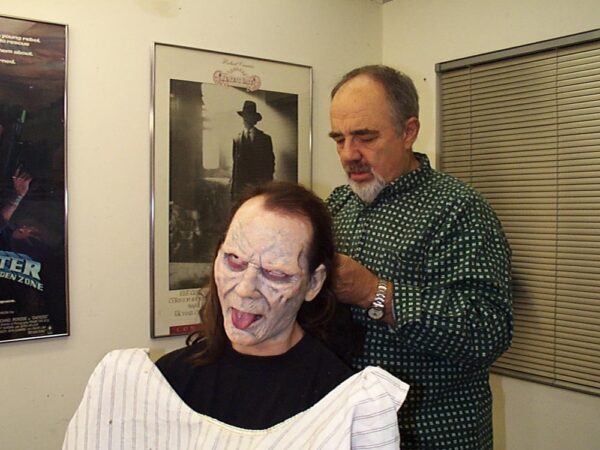
Building the perfect box-cover beast…
Fair warning: a considerable number of Planescape: Torment spoilers follow!
Baldur’s Gate, the only Infinity Engine game to precede Planescape: Torment, attempts very explicitly to recreate the pleasures of playing tabletop Dungeons & Dragons with your friends. The companions whom you collect around you could easily be the avatars of said friends. Each of them is an archetype — fighter, magic user, cleric, thief — which constitutes one part of a Gary Gygax-approved well-balanced adventuring party. The game employs the classic “a group of adventurers met in a bar and went questing” setup. There’s an overarching plot, but it’s really just an excuse to explore more terrain, fight more monsters, and grow steadily stronger. If you want, you can even play Baldur’s Gate together with your real-life friends, with each of you taking control of one character (although it’s rather clunky in practice, being subject to the technological limitations of the late 1990s).
Whatever else it happens to be, Planescape: Torment is nothing like that. It’s the very specific story of one very specific character, presented it a way that would never have worked with a gang of others sitting around the tabletop. Companions do arrive to accompany him, but they are always peripheral to his central psychodrama. There is no multi-player mode here. Having one would make no sense.
The protagonist of Planescape: Torment is the appropriately named Nameless One, a zombified shamble of flesh and bone who wakes up at the beginning of the game on a mortuary slab in Sigil, the city of inter-planar doors, with no idea who he is or how he got there. So, he sets off to try to find out. Along the way, he meets the aforementioned companions who join him on his journey. One or two of them he even meets in a bar, but these are not your typical happy-go-lucky adventurers with mercenary stars in their eyes. The fact is that each of their stories has long ago become interwoven with that of the Nameless One himself, generally to their detriment, and even though he can’t remember any of it. His own backstory will prove to be far longer and stranger than you or he might ever have thought possible, encompassing hundreds of lifetimes lived out all over the planes of existence, during which he has been good and evil and everything in between. His true quest, it will gradually become clear, is not merely to find out who he really is. Doing so is just a prerequisite to stopping the cycle of rebirths, owning his sins, and finally bringing his story to an end.
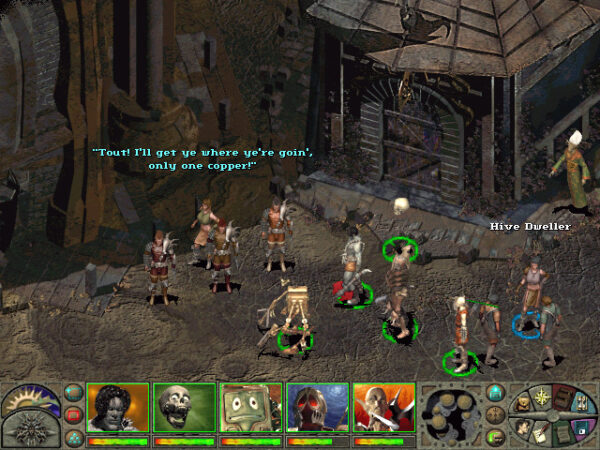
Planescape: Torment demonstrates the flexibility of the Infinity Engine. In keeping with the more personal focus of the story, the team at Interplay moved the camera in closer to show the characters on the screen better, condensed the interface down to a single bar at the bottom of the screen, and reworked the controls to make use of a popup, adventure-game-style radial verb menu.
Not only does Planescape: Torment subvert the traditional plot outline of a CRPG by turning a triumphalist power fantasy into a tragic journey of self-discovery, but it subverts many of the standard CRPG mechanics to serve its agenda. The Nameless One is immortal, which means that defeat and “death” in combat is a minor inconvenience at worst; he will always wake up once again on his mortuary slab, with all of his inventory, companions, and experience points intact. (In some places, he is even required to “die” in order to advance the plot.) With physical threats being thus robbed of their menace, a clever dialog response is almost always worth more experience points than defeating the same interlocutor in battle. Swords, armor, and most of the other usual trappings of heroic adventure are seldom seen, replaced by stranger concoctions, like a floating skull who can upgrade his attack by acquiring sharper teeth. Planescape: Torment is not your parents’ CRPG.
To wit: if you come to this game expecting a plane-skipping roller-coaster ride through a wide variety of environments, I’m afraid you’re destined to be disappointed. Most of it takes place within Sigil. You start out in the slums and eventually make your way to slightly posher districts of the city, but the general atmosphere remains one of futility and decay from first to last. I’m frankly not sure how to respond to this. My wide-eyed inner child, the one who used to consume pulpy sci-fi novels by the dozen, thinks it’s false advertising to promise us a city of doors to infinite possibility and then deliver only this sad-sack assemblage of run-down mundanities. My more mature incarnation, the one who studied (or in some cases suffered through) the literary classics at university, thinks it might be an admirable case of a game sticking to its guns. But even he begins to feel crushed under the sheer weight of misery on display here, begins to wonder what pathetic excuse for a multiverse this is that has such a squalid, nihilistic centerpiece.
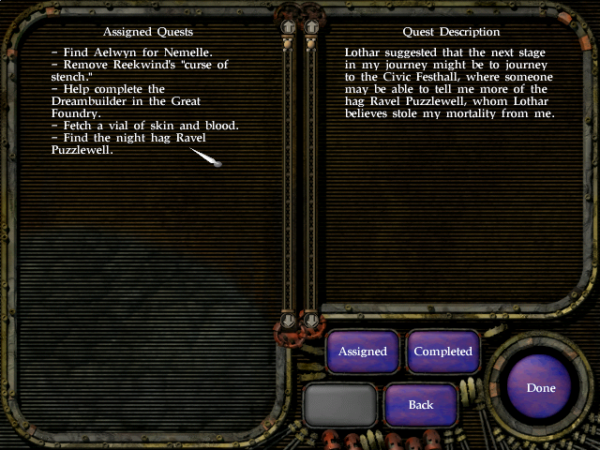
Planescape: Torment has its share of interface issues, but the quest log at least is far more usable than the one in Baldur’s Gate.
In practice, much of your time in Planescape: Torment will be spent wandering through each new district of Sigil as it opens up, clicking on every character who has a name or otherwise non-generic description in order to initiate conversation. Make no mistake. These people like to talk… oh, my God, do they like to talk. A minority of them have information or assistance to offer that pertains to the main quest, or at least to one of the many side-quests. Most of them, however, just “rattle their bone-box,” as the Sigil lingo goes, for the sake of hearing it rattle, telling you all about their hardscrabble lives in paragraph after paragraph of text. I find that it becomes numbing after a while, a symphony of despair that just keeps hammering away on the same relentlessly grim note. It’s Down and Out in Paris and London, except an order of magnitude longer in a different dimension.
The Cant — the Cockney-inspired lingo of Sigil — is striking, even if it is lifted from TSR’s Planescape boxed set rather than being an innovation of this development team. All the same, the writing has a rough-draft quality to it that includes but is by no means limited to the typos and minor grammatical errors that are strewn fairly liberally throughout, the well-nigh inevitable result of laying down so very much text in a relatively short span of time. It’s enough to make you long for the days when computers were primitive enough that even text was expensive, such that developers had to choose their words with care, had to make sure that every single one of them counted. Failing that, we might wish that someone in Interplay’s marketing department had insisted that the whole game be voice-acted, which would have served the same purpose of forcing the developers to include only those words that really matter. (As it is, only the occasional line or two is voiced.)
Editing, in any sense of the word, was clearly not a priority here. Back in the 1980s, Infocom employed a full-time editor from the book-publishing world to polish and tighten the prose in its games. But alas, such work was far beyond the core competencies of a 1990s studio like Interplay. The only guiding principle here seems to be the more words, the better. Matters reach a kind of absurd climax when you wander into a bar in which the patrons spout verbatim paragraphs from the old TSR Planescape campaign setting, copied and pasted into the computer game. One can easily imagine that the developers must have been paid by the word, the way people like to say that the similarly verbally incontinent Charles Dickens once was. Whether they were or not, talk is way, way too cheap in Planescape: Torment.
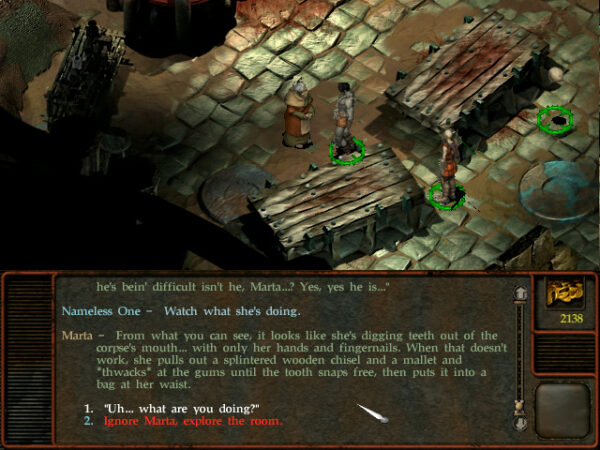
At times, you can almost palpably sense Chris Avellone and his friends straining to put words in the mouths of so many superficially indistinguishable characters in ways that might make them stand out. You want to tell them that it’s okay, give yourself a break: literary merit is not measured by the kilogram of verbiage. Occasionally the writing surrounding the many bit players of Sigil can surprise you with a clever metaphor or a flash of insight or compassion, but more often it just wallows in the squalor. Many of the grotesques you meet are gross just for the sake of being gross, thus revealing that the sniggering lover of blood and boobs who wrote so much of the pitch document remains a part of the development team’s collective unconscious if nothing else.
A man is looking at you with a strange, bug-eyed stare. His eyes are huge… so huge they look ready to pop out of their sockets and roll across the cobblestones. He nods eagerly as you approach, bobbing his head like a bird… and as you near him, you suddenly notice the smell of the urine and feces surrounding him. The man sniffles, wiping his nose on his sleeve, then opens his mouth to reveal blackened, rotted gums…
Reekwind coughs, his eyes almost popping out of his skull as he does so. His cough seems to loosen his bowels, for he breaks wind loudly, as if to accentuate his point…
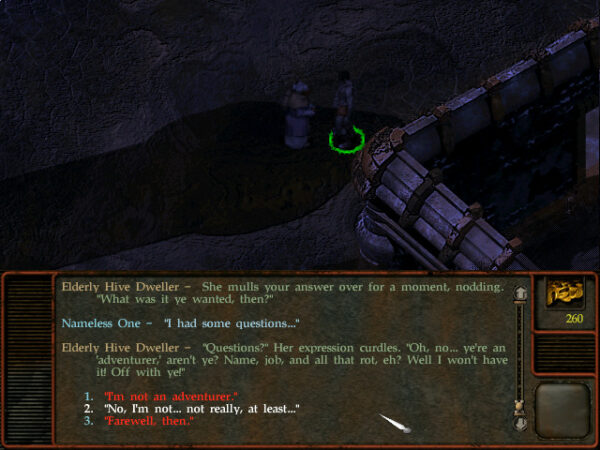
In a moment of levity, the game has fun with some of the tropes of golden-age CRPGs. “I’ll bet ye’ve all *sorts* o’ barmy questions! Greetin’s, I have some questions… can ye tell me about this place? Who’s the Lady o’ Pain? I’m lookin’ fer the magic Girdle o’ Swank Iron, have ye seen it? Do ye know where a portal ta the 2817th Plane o’ the Abyss might be? Do ye know where the Holy Flamin’ Frost-Brand Gronk-Slayin’ Vorpal Hammer o’ Woundin’ an’ Returnin’ an’ Shootin’-Lightnin’-Out-Yer-Bum is? I ought ta kick ye in the shins fer even pesterin’ a poor ol’ woman about it all!”
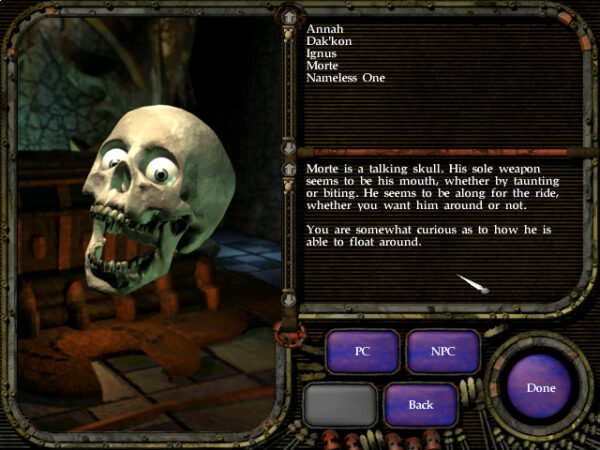
The companions with whom you hack your way through this forest of words instead of monsters are a mixed bag. Morte the talking skull is your first party member, already at your side when you wake up on the mortuary slab for the first time, already seeking to make up for having betrayed you in one of your earlier lives. His redemption arc aside, he’s clearly meant to provide a note of comic relief amidst the cavalcade of misery you encounter, even if in practice his humor misses rather more than it hits; the necrophiliac jokes about every female ghoul and zombie you meet get pretty old pretty quickly.
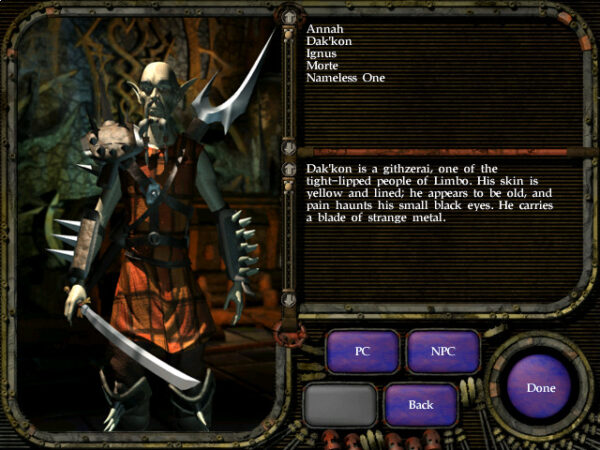
Your companion Dak’kon belongs to the githzerai, a planar race of ascetics who prize order and harmony over all else. Unfortunately for him, a crisis of faith has led to him being cast out by his own people.
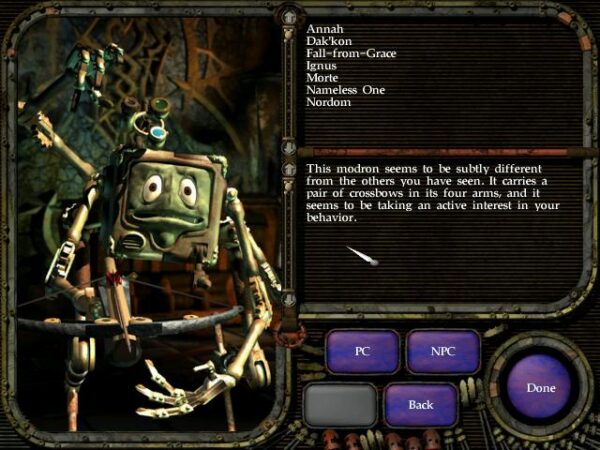
Nordom is not so much cast out as dropped in from what feels like it ought to be a different game entirely. Recruitable only via a lengthy side-quest that’s disarmingly easy to miss completely, he’s a robot who has evolved into sentience and is trying to figure out what to do next. He’s essentially WALL-E nine years before Pixar came up with him; he’s even drawn in a cartoon style, a jack-in-the-box with big, sad eyes and way too many gangling limbs.
And then we have the two female companions. They are defined by their gender and sexuality in a way that their male counterparts are not, occupying an uncomfortable liminal space between adolescent wish-fulfillment and earnest character-building. The pitch document tells you most of what you really need to know about them when it promises “to fill the game with deep, meaningful interactions with characters that happen to have swaying, pendulous breasts.” Both Fall-from-Grace the reformed succubus and Annah the reforming tiefling thief look like your standard videogame hot chicks. The way they’re written, on the other hand, arguably provides less fodder for students of literature or philosophy than it does for psycho-anthropologists who happen to be studying a certain subset of turn-of-the-millennium young men.
Fall-from-Grace runs the embarrassingly named “Brothel of Slaking Intellectual Lusts.” This establishment is full of hot chicks just like her, who invite their male customers in to… well, just to talk to them about all the nerdy interests that cause other comely young women to roll their eyes and start sidling toward the nearest exit.
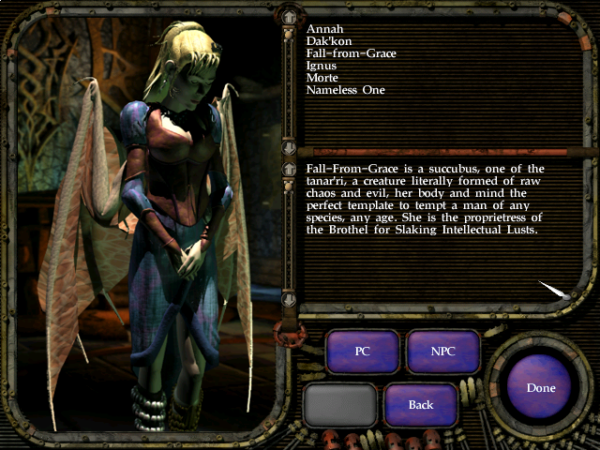
Annah is an apparently jaded girl of the streets who, it will eventually turn out, has never known the touch of a man (because of course she hasn’t) and thinks that The Nameless One might be the right one to finally teach her the ways of love (because of course she does).
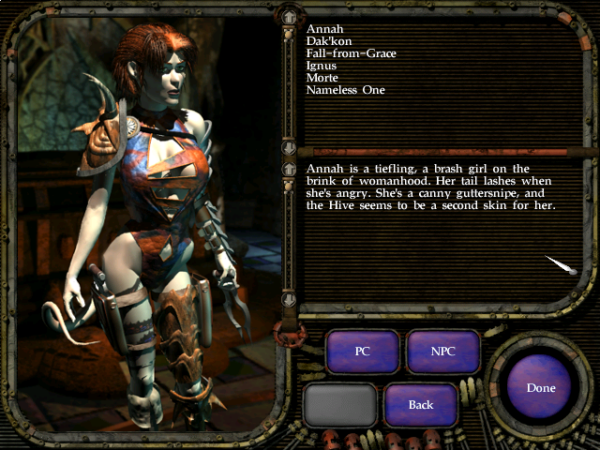
Fun fact: Annah the tiefling was voiced by Scottish pop singer Sheena Easton. Sadly, The Nameless One never does get to spend a night inside her sugar walls.
Now, I don’t want to jump all over Chris Avellone and his friends for this. I believe we should weigh intent at least as heavily as effect when passing judgment on anything, and the intent here is as sweet in its way as it is perchance inadvertently revealing. If the “babes, babes, and more babes” guy from the pitch document is the person these lads were with their peer group, then the wide-eyed romantic who came up with Fall-from-Grace and Annah was likely the person they became alone at night after their buddies had gone home. I remember seeing the girls I crushed on — the ones I really crushed on, that is — in much the same way when I was their age or only a little younger. To my teenage eyes, they were well-nigh celestial beings whom I wanted to shelter from the ugliness of the world (not least all those other guys who were better at sports than I was) and commune with in a way that transcended sex (not least because I was none too confident in my own abilities in that department in comparison to those other guys). It’s a phase a lot of us go through, but also one that we hopefully outgrow. The problem with such attitudes is that they still preclude one from seeing the object of one’s fancy as a fully-realized human being with a full measure of agency in her own right. Men have been using these velvet cages, sometimes consciously and sometimes unconsciously, to hold women down since time immemorial. The women of Planescape: Torment contribute to the sense of a writing team who are punching a little too far above their own weight — or, maybe better said, their life experience.
The overwriting and the gawkiness are present in the main plot line as well. Below is a short extract from the game’s turning point, a long-sought-after and predictably prolonged dialog with Ravel Puzzlewell, a witch who knows much about The Nameless One’s real nature.
“A shadow with substance, a-seeking that which casts the light. I know you more and no… know…” Ravel pauses, her eyes dimming. “No more than I know the nature of ANY man. Crossed pasts have we… a man tainted with un-death, still feeling the pangs of separation, and an old withered crone, now all-imprisoned. Seems it that we are a-meeting for the first time? No, no, not, not… knot?” Ravel seems confused for a moment, then shudders, as if throwing off a weight. “Knot at all. An echo of a future meeting this is… or a past meeting, depending on which way time is facing.”
The first thing we notice here is the inverted sentence structures of Yoda-speak, a kind of default setting for mysterious and profound characters in way too many games. It serves to remind us that, for all their aspirations toward Philosophy, these writers are better versed in the works of George Lucas than Aristotle or Nietzsche.
Meanwhile all this punning on “know” and “no,” “passed” and “past,” “not” and “knot,” is the sort of thing that clever and ambitious young writers often turn out, and grizzled and remorseless editors draw a line through just as quickly. For it works only on the page (or the screen, in this case); if it was spoken, as we’re supposed to imagine dialog being, it would all fly right past the interlocutor. In the end, then, the only purpose it serves is to point out the cleverness of the author, which isn’t — or oughtn’t to be — the purpose of writing anything. If we keep at it long enough, most of us writers learn to nip such cherished little darlings in the bud before they can pull our readers out of the story we’re trying to tell.
And now, looking back on what I’ve written, I see that I’ve been hard on Planescape: Torment, harder than I really intended to be. And yet there are criticisms I haven’t even gotten to yet. For example, I haven’t mentioned how unsatisfying and annoying the combat is — yes, it does exist, and is actually quite extended and extensive at times, such as when you have to leave the streets of Sigil to delve into its tombs and sewers, or when you leave Sigil’s dimension entirely during the last quarter or so of the game. (Never fear: the other dimensions you visit are if anything even bleaker than this one.) Ironically, the same changes to the Infinity Engine that make this game feel more personal than the likes of Baldur’s Gate also serve to explain why Bioware made the choices they did for their own, more conventionally combat-oriented CRPG. Here, the close-in camera makes it harder to keep track of what is going on during a fight, even as the other interface changes make it harder to micro-manage your party when you really need to. Most of the standard CRPG elements — character levels, ability scores, spell books, etc. — feel like phantom limbs here; tragic psychodrama makes a strange fit with the power fantasy of Dungeons & Dragons. The final impression which I just can’t escape is that of an engine and system of rules which are badly out of sync with the game they’re being asked to present. If you want to call that further evidence of subversive intent on the part of the development team, be my guest. I just call it unfortunate.
For all that, though, I don’t want what I’ve written to read as an invalidation of the experience of those who have played Planescape: Torment and felt a wind of profundity blowing through its dreary environs. I’ve felt the same wind myself. (And no, I’m not talking about our friend Reekwind.) As you learn more and more about The Nameless One’s endless cycle of pain and suffering, both caused and endured, themes and ideas that games seldom touch on begin to emerge. One particular question is brought up again and again: “What can change the nature of a man?” To its credit, the game never offers a definitive answer, but two possibilities come to the forefront: “Regret” and “Belief.” As Saint Augustine tells us, these are two sides of the same coin: the weight of Regret engenders Belief, while our Belief fills us with Regret for all the ways we fail to live up to our moral potential. Thus the need for Confession to cleanse our souls and be worthy of that which we believe in… and so the cycle continues.
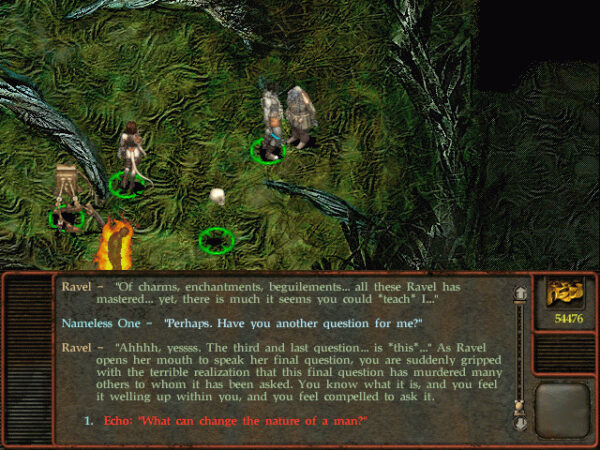
In a revelation that genuinely shook me, you learn near the end of the game that resurrection isn’t free, that every time The Nameless One is brought back to life on his familiar mortuary slab after a failed combat or some other misguided escapade, the life of some other poor mortal schmuck is taken in compensation for his rebirth. The “best” ending has him breaking that cycle by recognizing, acknowledging, and internalizing the suffering he has caused, looking that unwanted self-knowledge and its terrible consequences straight in the face. What follows is by no means conventionally happy, but it is the only fitting way to bring his story to a close. Kudos to Chris Avellone for not chickening out at the last minute, as other game designers have done.
Planescape: Torment is the first game of any stripe that I know of since Infocom’s Trinity to unabashedly don the mantle of Tragedy in the classical sense. Although Chris Avellone’s understanding of what that means is perhaps less nuanced than that of “Professor” Brian Moriarty, the author of Trinity, his take on it is more searingly immediate. For Trinity is the tragedy of an entire civilization, bereft of any characters at all who aren’t bit players, while Planescape:Torment is the tragedy of an individual whom we come to know all too well. Regular commenter P-Tux7 asked in response to the first article of this little duology of mine whether “it is right to punish someone who doesn’t remember doing the crime,” whether “someone can ever become not the person who did the crime,” and whether “justice demands an equivalent amount of suffering.” Such questions constitute the essence of tragedy, which writers have been struggling with as long as the written word has existed.
Despite all its granular failings of execution, then, Planescape: Torment leaves us with much to ponder, regarding both the nature of a man and — on a slightly more plebeian note — the nature of game design. Some of the themes that this game broaches are among the most profound we can wrestle with as human beings. The story of The Nameless One rhymes with the myth of Oedipus, who also looked terrible self-knowledge right in the face and had his soul shriven to the core. Or we might choose to read The Nameless One as a Christ figure, who redeems his fallen companions through a supremely unselfish final sacrifice. But there are likewise obvious parallels to Eastern religion and philosophy, which stress the need to escape the very same eternal life that Christianity purports to offer us. Meanwhile the existentialists among us must ponder whether a Nameless One who can’t remember the actions of his previous incarnations, who possesses no obvious continuity with his previous selves, can be said to truly be the same man at all. In fact, can any of us be said to be the same person we were when we were younger? After all, time is a river that changes all of us second by second, and, as Heraclitus told us almost 3000 years ago, it is impossible to step into the same river twice. Any game that can make its player ponder such thoughts as these is not to be dismissed lightly.
At the same time, though, Planescape: Torment belongs to a category of critic’s darling that always seems to get my curmudgeonly dander up (and tends to land me in hot water with some of my readers): games which are said to be so ridiculously effective as stories and settings that any gameplay inconveniences that dog them pale into insignificance by comparison. Grim Fandango is one of these: we’re told to forget the clumsy interface and nonsensical puzzle design and just enjoy the ride with a walkthrough by our side. Final Fantasy VII is another: forget the endless cavalcade of tedious random encounters and the fact that you can win all of them just by pounding the “attack” button over and over and enjoy the story. No matter how hard I try, I can’t see my way to giving games like these a pass. I love a good story and setting, but the fact remains that interactivity is the defining attribute of a game. It seems to me that it needs to work well too if we are to start throwing around accolades like “masterpiece.”
Much of what strikes me as flaws in this particular would-be masterpiece could have been fixed with a little more time and some more judicious oversight. The writing could be pared down at the same time that it was polished up; 800,000 words are not needed to convey a vivid sense of place and atmosphere, only a subset of the right ones. The tedious combat could be overhauled or perhaps eliminated entirely. Indeed, I sometimes think that my ideal Planescape: Torment would be a ten-hour point-and-click adventure game that doesn’t waste my time with unneeded mechanics or unnecessary talk, that makes every moment count. I doubt that Chris Avellone would go that far, but, again, I sense that he may just agree with me about some of the game’s infelicities. It’s just that he would prefer to improve the other systems rather than narrow the focus to the core story. “If the moment-to-moment gameplay is lacking,” he says, “then you’ve failed as a game designer. The combat was pretty weak, and I did feel it could have used more dungeon-crawling areas for players to explore and have fun in in addition to having fun exploring the conversations in the game.” Who knows? Maybe that would work too.
For when it comes right down to it, I still don’t know quite how to feel about Planescape: Torment; when I called it confounding at the start of this pair of articles, I meant it. I first tried to play it not long after it came out, only to give up after a few hours, bored by the depressing setting and all of the people there who never shut up. I returned to it in order to write these articles, and my sense of professional duty carried me all the way through this time around, even though I was once again bored for much of the time. Still, I’m glad I stuck it out, glad to truly know one of the most celebrated computer games in history. Yet I must confess that I’m equally glad to be done with it. I am of the opinion that the most fundamental responsibility of a game, before theme and meaning can even enter the discussion, is to entertain or at least interest its player. Planescape: Torment failed that test too often for me to call it a great game. If you want me to call it a brave and intriguing one, though… well, that I can definitely get behind. Seldom has any group of creators in this field challenged the expectations of their audience so thoroughly. And that in itself is a brave feat well worth applauding.
Did you enjoy this article? If so, please think about pitching in to help me make many more like it. You can pledge any amount you like.

Sources: The book Beneath a Starless Sky: Pillars of Eternity and the Infinity Engine Era of RPGs by David L. Craddock; Computer Gaming World of March 2000 and April 2000; the 2015 GamesTM special issue on “controversial” games; Retro Gamer 113. Plus the materials found in the Brian Fargo Collection in the archives of the Strong Museum of Play.
Online sources include Soren Johnson’s interview with Chris Avellone for his Designer’s Notes podcast, a Last Game Standing interview with Avellone, and Guido Henkel’s pictures and memories of posing for the Planescape: Torment box cover.
Where to Get It: Planescape: Torment is available as digital purchase from GOG.com in an “enhanced edition.” Buying it also gives you access to the original version.





Jack Brounstein
June 8, 2026 at 6:45 pm
I hear everything you’re saying, but I what appreciate most about Planescape: Torment is the somber tone. It just feels so different than playing other games.
If the next article isn’t about Metal Gear Solid, you missed a golden opportunity to do a “revered games that have a lot on their mind even if they aren’t as smart as they think they are, and also there’s an off-putting adolescent streak, including but not limited to the treatment of women, mixed in with all the philosophizing” theme month.
Ahab
June 9, 2026 at 11:29 am
Metal Gear Solid also proves that just because the game is entirely voice acted doesn’t mean the writers will be more economical with their words.
Kai
June 8, 2026 at 6:54 pm
As someone who enjoys cRPGs for their fantasy settings and story-telling, and less for the usually prevalent combat encounters (I guess combat was cheap and easy to do on computers, whereas the rest of the RPG experience was not, so combat was what we got in abundance), Planescape: Torment always stood out to me as a singular experience, and even more so for its singular setting and the equally singular lingo (which back then I couldn’t place as any existing dialect).
Having come from Baldur’s Gate, where I felt the only available conflict resolution was death of quest-target or quest-giver, a game where you could *talk* your way out of combat and to quest-completion more often than not, and for a greater reward too, felt revolutionary to me.
Plus, as much of a trope the amnesiac might be, it was a brilliant choice, as instead of having to content with lots of exposition, you got thrust into the world and could soak it up like a sponge as you went. Excitement and new discoveries waiting around every corner; to me it was anything but boring!
If the game is to fault for something, I’d say it’s for not adhering more consistently to its formula throughout, necessitating tiresome battles against forgettable mobs, and for requiring a certain character-build to get the most out of it. I guess I endured the former, and got more or less lucky with the latter, but I could imagine how one or the other could ruin the experience.
Mike
June 8, 2026 at 7:20 pm
I feel like you’re going to get a lot of “yeah sure, but…” feedback on this one, and that’s what I’ll offer too.
To me, the strength of Torment, the thing that made it stand out to me, was how much your choices actually mattered. In most games, you were either railroaded onto the only possible choice, or given silly good/evil paths. Torment gave you real choices almost everywhere in the game — you could shape how the main plot went, as well as what happened to your companions, in ways that were genuinely significant. Your choices mattered in a way they rarely do.
(I’d argue that the next game to get up to Torment’s level in this sense was Dragon Age: Origins, which also was better in a whole bunch of other ways, while having its own flaws.)
Gwydden
June 8, 2026 at 7:37 pm
I’m sure you’ll get a fair bit of pushback, so if it’s any consolation, I feel much the same way about my attempt to play Torment: I found it overwritten and not nearly as smart as it thinks it is. I also agree that after all the talk of how cool and weird the setting is, the dreary pseudo-Victorian dung heap the game mires you in was disappointing, and there was way more combat than advertised, all of it pretty miserable. I can’t help suspecting the overblown praise it gets mostly comes down to people who first played it when they were very young and impressionable.
Still, it was a different time, and I get the game was trying something novel by those standards. I can see why it may have seemed more impressive in its proper context. Personally, I find the modern RPGs it’s inspired far superior; largely, I believe, because they learned from the mistakes of their predecessor.
Kalin M. Nenov
June 8, 2026 at 9:04 pm
When I watched a (very comprehensive) playthrough of P:T several years ago, I was astonished by something I’d overlooked in my previous encounters with the game: the extent to which the majority of side quests–even the smallest ones–resonate with the main themes: changing one’s nature, redemption, and so on. They explored, played with, or at the very least hinted at those themes so often and in so many ways that, in a sense, they could no longer be called “side” quests; they became facets of the main story. I’m not aware of any other CRPG that ties in its material so tightly; if anyone here is, please let us know.
Another type of recommendations I’m looking for are CRPGs whose writing is particularly effective; or however you define the opposite of “overwrought”. I’m specifically asking about games with graphics (as opposed to pure text). Like Jimmy, I was (and still am) a reader before I was a gamer; unlike him, I had a field day with most of those 800,000 words. So much so that I devoured _both_ novelizations of P:T I could get my hands on. (Say … are there more than two? I think they left out two or three hundred thousand words. :D)
Gwydden
June 9, 2026 at 12:01 am
Pillars of Eternity is a spiritual successor to Baldur’s Gate with some Planescape: Torment DNA spliced in. It’s big thematic question, spelled out at the very end, is along the lines of “What if we can’t be assured of anything?” If there’s no objective meaning, what do? You know, basic existentialism stuff. I think every single companion quest deals with this theme, and a lot of other sidequests, not just the main quest.
I do think it suffers from some of the PS:T issues outlined above, albeit to a lesser extent: overly verbose writing, too dreary in places, not always quite as incisive as it’s clearly trying to be. Good as it is, I believe the sequel—which has more political themes such as the legitimacy of traditional authority and what is worth sacrificing for change—improves on the writing substantially. But that’s a controversial opinion.
But I’ll also be boring and say that the best written CRPG, in my opinion, is Disco Elysium, which is explicitly a PS:T spiritual successor and one that does succeed at being everything the older game is often claimed to be.
WellTemperedClavier
June 9, 2026 at 1:12 am
Disco Elysium definitely did a better job of what P:T was trying to do. It helped that DE wasn’t encumbered by the D&D formula.
Kalin M. Nenov
June 9, 2026 at 9:18 am
Thank you both!
I’m aware of both games. I couldn’t last past the first two hours of Pillars; there was nothing in the dialogues or story that promised any hooks for the kind of themes or interactions I crave. Compare that to the very first exchange between the Nameless One and Morte, culminating in forcing Morte to read _all_ the tattoos on the Nameless One’s back–including, “Do not trust the skull.” Boy, was that some hook. :) However, now I may give the second Pillars a chance.
Disco Elysium did hook me up from the very start. I’d even argue its opening scene has the best, most unhinged writing in the game (which is a recipe for disappointment :/–but yes, it’s terrific). What really soured my experience was the ending, which I found impotent and bathetic (“Seriously? _This_ is what has caused all this turmoil?”) Compare to the ending of P:T. It is an actual reminder what ‘pathos’ meant originally. :)
Please keep them coming. :)
Here’s one from me: the Pathologic series, especially the second and third installment. In many ways, the themes are deeper (and certainly more impenetrable) than P:T. However, it’s also far grittier than P:T–some people call it a “game with no entertainment factor”, especially the second part. So Jimmy will suffer even more should he get to it. A helpful hint: just like in P:T, death isn’t all it’s cracked up to be. Not just your death: everyone’s. ;)
Gwydden
June 9, 2026 at 11:03 am
I keep thinking I should try Pathologic. Thanks for the rec.
Regarding PoE1, I’ll say I also abandoned it a few hours in the first time I played it and only came back to it years later. I think Act 1 is the weakest part of the game and does a poor job of hooking the player. But yes, I believe PoE2 is better in every way. Tyranny, the sort of spinoff in a different setting, may also be more your speed; I believe Avellone was heavily involved in it.
If we’re moving beyond strictly CRPGs… My favorite video game writer is Alexis Kennedy. Sunless Sea is worth trying, but his best work is with his second studio: Cultist Simulator, despite the silly name, is the best “wizard” game I’ve played, a tale of uncovering occult mysteries and obsession in the pursuit of immortality; also a game I had to start a few times before its gameplay clicked, in fairness. Book of Hours is a more chill occult librarian sim in the same universe, and he’s soon adding to this “series” a Disco- and Planescape-inspired CRPG called Travelling at Night.
In my opinion, he’s a much better prose stylist and more creative game designer than Avellone, and while his games are grim, he has this melancholy, romantic sensibility that is rare in video game writing and that really appeals to me. Atmosphere and themes are my priorities as a reader, and his games excel at those. On the other hand, their style means he hasn’t had to do much character or dialogue writing; Travelling at Night will show if he’s up to the task.
Kalin M. Nenov
June 9, 2026 at 2:56 pm
Thank you very much! Most of these (except for Sunless Sea) are new to me. Adding to my list.
(Saddest thing about Avellone’s writing: later on, it never comes anywhere near what he–and his co-writers–did in P:T. Someone mentioned Zelazny and his Amber chronicles. There’s another writer with the same curse. Try “A Rose for Ecclesiastes” and compare it with his later works. :( Or, for an even more baffling example, Piers Anthony’s _Macroscope_ vs. all of his Xanth novels.)
James Neal
June 9, 2026 at 6:00 pm
Pathologic 2 is literally the greatest video game ever made. I am a hardcore will die on that hill Pathologic 2 fan in the way that Torment fans are about Torment (actually I think Torment is pretty great just Maher’s criticisms are all pretty fair).
Kalin M. Nenov
June 10, 2026 at 4:35 am
Judging by the evolution of Pathologic’s themes, I suspect part 4 (the Changeling) will be my favorite one. :)
With my obsessive desire to fix _everything_, Pathologic 2 would’ve been really, really stressful. So I watched someone else play it. It did help that they played well; and engaged with most of the philosophical questions in earnest.
WellTemperedClavier
June 9, 2026 at 10:07 pm
I had a similar reaction to Pillars, though in my case it was more due to the combat seeming like too much of a chore to wade through (and my impression was that PoE would have a lot more combat than P:T).
Interesting stance on DE’s ending. I personally thought it worked pretty well. Not as dramatic as P:T, but a meaningful example of the human cost that comes with change. I thought it fit in pretty well with the game’s overall tone.
I’ve heard a lot of good things about Pathologic. Might give it a try if I ever have time.
Mateus Fedozzi
June 8, 2026 at 9:16 pm
Fair article. There’s not such a thing as a perfect Interplay game, but there’s also no Interplay game which I would never play or even recommend, because these guys were always throwing new things at the RPG genre. Sometimes boring, most of the time broken, but always interesting.
Also, I think I’ve finally understood you prefer your gaming narratives on the lighter, more humorous side of things. This is not a criticism at all, it’s just that it’s just now that I have noticed this trait of your persona(lity). It even feels as if you will never allow gaming narratives to take themselves too seriously, because video games. And video games can’t be all that serious. Maybe this a leftover from your younger days, playing Infocom and other adventure games? I don’t know. But it’ll make me read your future articles, of which I hope there still will be thousands, in another – brighter? – light.
Kalin M. Nenov
June 8, 2026 at 9:22 pm
On a more contentious note, the only thing that irritated me in this article was the dismissive qualifier “pat” about any explanations that see the infamous pitch document as satirical/sarcastic. Ever since I read the pitch years ago, I’ve found it so _blatantly_ tongue-in-cheek that I’ve never even considered the idea anyone can see it otherwise. So I can only ask: What makes you think those quotes above are meant to be taken in earnest? Especially the “babes” one?
(I already talked about this and gave a counterexample in my comments on part 1 of this article.)
Gwydden
June 8, 2026 at 11:48 pm
I’ve met guys who literally think and talk like this, and that’s now, in the 2020s. And frankly, there’s no meaningful difference between someone who thinks saying that kind of stuff is funny and someone who earnestly believes it; the former’s just a front for plausible deniability.
Kalin M. Nenov
June 9, 2026 at 9:32 am
“there’s no meaningful difference between someone who thinks saying that kind of stuff is funny and someone who earnestly believes it” is a leap of logic/psychology that my mental legs aren’t ripped enough to make. ><
Seriously though, if you've done any kind of creative plot-based work (or just enjoy people watching), you've certainly found yourself inhabiting characters/interpreting types that you wouldn't touch with a ten-foot pole in real life. Haven't you? Does this equate you with them in any meaningful way?
Percapit
June 9, 2026 at 8:29 pm
Good thing nobody needs you to make leaps of any kind. Yes, let’s pretend they were simply playing the role of sexist creeps to appeal to other sexist creeps. That makes it so much classier.
Kalin M. Nenov
June 10, 2026 at 4:27 am
Or let’s pretend we actually know what they meant to do. What does that make us? :)
Adamantyr
June 8, 2026 at 9:40 pm
A fair review. I re-played P:T about two years ago when the enhanced edition became available, and noticed some things.
In particular, when you literally have to explain the entire setting to explain WHY it’s deep, you’ve lost the narrative. Strip everything away and it’s basically “Guy knows he’s going to hell, becomes immortal to try and fix things to not go to hell, backfires and he ends up doing even worse things and goes to hell anyway.”
I definitely noticed the 12-year old boy’s design in many places; pretty much every NPC woman who isn’t a unique character is a prostitute with exaggerated proportions.
I think they also missed out on one particular idea; if they had made the Nameless One androgynous, they would have been a much better protagonist to represent everyone. I guess though it was a number of years too early for that kind of thinking. Plus, again, 12-year old boy in charge wants a powerful Frankenstein-looking man in there.
I would say though it was a unique CRPG in that it was one of the few where you actually benefited from putting points into Intelligence, Wisdom, and Charisma. You would get much better dialogue options.
Even at the time of P:T’s release the 2nd Edition AD&D rules were frankly archaic and absolutely unsuitable for almost every setting. Planescape isn’t alone at being a square peg in a round hole; the Dark Sun setting felt like it SHOULD have had it’s own unique system built for it, but they shoved 2nd Edition in there even though it really doesn’t work for it at all.
I DID like the end-game spells, most of which had a cinematic play when you cast them, like Mechanus Cannon.
WellTemperedClavier
June 8, 2026 at 10:41 pm
In your first article, you mentioned that the game had elements that might seem deeply profound to someone in their twenties, but rather trite to someone in their forties. And as someone who played the game in his twenties and is now middle-aged, that struck home. I love P:T, but playing it absolutely does feel like talking to a college student who’s clearly quite intelligent, but also convinced that nobody’s ever had the kind of deep thoughts they’re sharing with you.
This doesn’t bother me too much; that’s an important thing for people to grow through (and Lord knows I was no better at that age). But you can’t take it quite as seriously when you’re older.
I don’t remember being especially bothered by the bleakness of Sigil, but everyone’s tolerance for that kind of thing will vary. Most of the oddities engaged me more than repelled me. But I completely agree that this probably would’ve been a better game if they’d dispensed with combat altogether. Combat is not the Infinity Engine’s forte, and it’s all the more glaring in a game like P:T which seems actively disinterested in fighting.
Anyway, kudos on writing what is, in my mind, an honest and fair-minded review!
Michael
June 8, 2026 at 11:07 pm
Two small typos:
“girls I crushed on – the one” (assuming there was more than one so it should be “the ones”).
“…oversight The writing” (missing a “.”)
And one comment:
The most horrific piece of the pitch document, for me, is that the writer explicitly placed “human babes” and “Asian babes” in two separate categories.
Jimmy Maher
June 9, 2026 at 8:43 am
Thanks!
Jeff Sampson
June 9, 2026 at 2:12 am
Roger Zelazny’s Nine Princes in Amber novels were also a big inspiration(and the SNES Shadowrun, according to Gamespot): https://www.gamespot.com/articles/the-greatest-games-of-all-time-planescape-torment/1100-6135401/, but since I never read them I don’t know how much they influenced the final product. I do know the planes are supposed to encompass the entire D&D cosmos, so technically the setting isn’t supposed to be just the equivalent of Hell, but maybe the Planescape box set and books(which I glanced through) made everything grotesque to compete with the Vampire Masquerade line.
I remember loving Torment, but I don’t remember much because I was left pretty satisfied by my one power gaming play through, where I was so maxed out I could pick multiple options at the end. Whereas I remember Baldur’s Gate II very well, not because I played through more than once, but because the sheer length made it memorable, and not always in a good way compared to the much tighter Torment.
WellTemperedClavier
June 9, 2026 at 2:30 am
I didn’t play Baldur’s Gate until long after it came out. While I can understand why it was as influential as it was, the combat engine made it hard for me to really embrace the game (and I never bothered with the sequel despite all the good things I’ve heard about it).
It’s kind of funny since P:T feels awkward by virtue of not wanting to deal with combat despite being expected to, but BG feels awkward by having a lot of combat that just wasn’t fun (at least not for me).
Feldspar
June 9, 2026 at 2:54 am
Every time I see a screenshot of this game it always feels like it takes place across an infinite number of universes, all of which are the same shade of brown.
Zed Banville
June 9, 2026 at 6:02 am
Planescape: Torment released in the era of “Fifty Shades of Brown” art design for computer games (some games taking place indoors in a dungeon had “Fifty Shades of Gray” art design instead).
RandomGamer
June 12, 2026 at 2:48 pm
PS: T was calibrated to run on CRT monitors, which worked differently than LCD’s in terms of how saturation curves worked.
At the time of its release, it was reasonably colourful.
Jimmy Maher
June 9, 2026 at 8:36 am
You can have a universe in any color you like, as long as it is brown.
Zed Banville
June 9, 2026 at 5:57 am
“Whatever else it happens to be, Planescape: Torment is nothing like that. It’s the very specific story of one very specific character, presented it a way that would never have worked with a gang of others sitting around the tabletop.”
This was a formula that, by 1999, had already been expressed many times by RPGs in the “JRPG” subgenre, though these games were console releases that only rarely made their way to PCs.
The cinematic powerful spells are probably also a JRPG influence, specifically from Final Fantasy VII.
John
June 9, 2026 at 3:00 pm
Torment is one of those games that, as a guy who thinks he likes RPGs, I sometimes feel as though I ought to play, but at this point I likely never will. I’ve gone back to play other classic and cult-classic games that I missed out on when I was younger and poorer and the results have been regrettably hit or miss. I’m sad to say that not only have the misses have outnumbered the hits but the misses have brought me more pain than the hits have pleasure. It always feels bad to buy a game, play it, and not like it, but it feels absolutely terrible to buy a game, play it, and not like it when you’ve heard other people singing the game’s praises for literally decades. Knowing what I do about the game and about myself, I don’t think I’d like Torment. I’m not fond of narrative-heavy games, I haven’t liked Avellone’s writing in the other places I’ve encountered it, and there’s just no way I could possibly like the game anywhere near as much as the people who played it near release and who have been hyping it up ever since.
Infinitron
June 9, 2026 at 3:05 pm
Jimmy:
You generally seem not to like the style of many of the more “narratively ambitious” titles of the 1990s. You’re a 1980s guy, not your thing, I get it.
But one exception to that is Ultima VII. Were the conversations in U7, and especially Serpent Isle, really that much less tedious than those of Planescape: Torment?
Jimmy Maher
June 9, 2026 at 3:17 pm
I’m afraid I have to reject the premise of your question on three levels. First, I have more fun with 1990s games than I did with 1980s ones. Second, my Hall of Fame is full of narratively ambitious titles from that decade. And third, I didn’t much like Serpent Isle… ;)
Infinitron
June 9, 2026 at 5:52 pm
I suppose I’m using a particular definition of “narratively ambitious”. I’d say it revolves around relatively extensive volumes of writing and a kind of cinematic or literary pretension operating within a nerdy “genre” space. From Wing Commander II to Planescape: Torment, there’s a common thread here. What those games were trying to do didn’t work for you.
Percapit
June 9, 2026 at 6:14 pm
Can’t say I’m much of a fan of twofaced weasels, Infinitron. Considering you just posted “The Antiquarian’s standards have dropped since he went from publishing articles weekly to biweekly. He did that because he doesn’t really care that much anymore.”
Percapit
June 9, 2026 at 6:05 pm
Infinitron and the conservative Codex crowd wants to pigeonhole you because you dared have an unapproved opinion.
Infinitron
June 9, 2026 at 7:05 pm
Oh snap, you caught me!
Percapit
June 9, 2026 at 8:31 pm
I like how you had to rally the troops to defend your honor. Because I’m sure they’ll all run to your aid after they finish posting some more anti-Semitic slurs.
Mika Oksanen
June 9, 2026 at 3:06 pm
Nearly all computer role-playing games that are not combat-oriented appear to be quite grim. For example, Disco Elysium is even grimmer than PT (to which it has often been compared), and grim in a more prosaic way. Tides of Numenera, which was advertised as a spiritual sequel to PT, is not quite as grim, but it is also set in a decaying Dying Earth. Now they are planning a Vampire the Masquerade game inspired by Disco Elysium, which is also sure to be gloomy. I wonder why this is?
Play History
June 9, 2026 at 4:22 pm
Esoteric Ebb – which is a “Disco-like” – isn’t all that gloomy. You shouldn’t really be surprised that World of Darkness is going to be a bit depressing.
Veronica Sanders
June 28, 2026 at 8:26 pm
That’s easy- because “grimdark” is what the young men writing all these things think is what it means to be deep and intellectual.
Play History
June 9, 2026 at 4:37 pm
This post set at least one server off on a long discussion about what is good video game writing.
I know you’re tackling the general insecurity of game storytelling with your criticism, though I do also feel that you want the game to be something it’s not. I’m not here as some grand Torment defender as I’ve only played the opening, yet in all the examples you pulled I fail to see a fundamental problem with the style. Could it be edited? Sure, but I fail to see how it doesn’t express itself the way it intends to or is fundamentally overwrought.
I’ve never been someone to critique writing line-by-line as I’m a bit more of a gestalt adherent. Prose is simply a lens by which you engage with a story. Some is better than others, but I don’t really think that Jordan is lesser than LeGuin because the latter uses more words. Likewise, someone could dismiss Austin vis a vis Dostoevsky for things that are ultimately subjective. You connect more with Trinity than Planescape; that’s fine. What I think is hard to swallow is using that opinion as reason to view only the worst in the latter – like I don’t think the Brothel of Slaking Intellectual Lusts is a fetish, it reads to me as a joke subverting your expectations.
Can and should games be shooting for more in their storytelling? Absolutely. But every project has its own lens. Planescape: Torment through the Dungeons & Dragons lens is a successful elevation of one aspect, whereas something like Baldur’s Gate 3 is another. Both I think deserve respect for that even if they are not quite to “literary” standards. I don’t think that is or should be the ultimate goal.
Gwydden
June 9, 2026 at 5:57 pm
“I’ve never been someone to critique writing line-by-line as I’m a bit more of a gestalt adherent. Prose is simply a lens by which you engage with a story.”
This will be a stumbling block in discussions like this because readers tend to fall pretty strongly on one side or another of the divide. I see prose as literally everything; a literary story is nothing but words strung together line by line, so one fundamentally *cannot* write well if one is not a good prose stylist.
“[…] but I don’t really think that Jordan is lesser than LeGuin because the latter uses more words.”
I used to be a huge Wheel of Time fan in my tweens (I assume that’s the Jordan you mean?), and Le Guin’s my favorite writer these days, and this comparison struck me as odd. Jordan uses far more words than Le Guin does. All of Le Guin’s novels—with the exception of Always Coming Home, which arguably isn’t even a novel—are pretty short.
“Can and should games be shooting for more in their storytelling? Absolutely.”
They can. Should they? I don’t know, it’s totally fine for an RPG to just want to tell a fun by-the-numbers adventure story or whatever. Even doing that much isn’t as easy as it looks, and unlike books, video games are usually juggling more than just the quality of their writing.
“What I think is hard to swallow is using that opinion as reason to view only the worst in the latter […]”
Ultimately, you are correct that taste in stories is entirely subjective. Dune is one of the worst books I’ve ever read, but I keep hearing otherwise; on the other hand, every single time I’ve mentioned to someone who’s read The Magicians that it is one of my favorite novels, my interlocutor said they didn’t care for it or even hated it. It’s fine. It is more interesting to discuss diverging taste in stories than, say, in ice cream flavors, but not vastly more meaningful.
Play History
June 9, 2026 at 6:34 pm
I did indeed mean “former” when I said “latter” in comparison.
Also while I’m here, Austen*
Jason Dyer
June 9, 2026 at 7:00 pm
Critique of game prose style is something I surprisingly haven’t gotten into much at All the Adventures because so many of the games (in the early era) by technical necessity have sparse text. (Even Infocom in 1980-1983 had to keep very tight; lots of the rooms in Deadline are very matter-of-fact, and I’m not going to judge them for not having an immortal description of a hallway.)
I always am cautious about dismissing criticism as “just subjective” though – I mean, do our words have meaning _at all_ then when doing a critique? Should everything be 5 out of 5 stars? I do think contextualization matters and a piece of prose that is perfectly good in a novel might fail utterly its purpose in a technical manual. Some books have a prose style intended to “stay out of the way” of the reader; it’s when there’s failure _within this contextualization and purpose_ where I think works really fall down, where the author has brilliant prose for 100 pages but ran out of energy by the end and revert to cliches for the last 10.
In this case of this particular article, I do think I’m not seeing enough evidence of weak prose in what got pulled out – the very specific example seems to be bothered more with characterization than the actual words being used. Given what happened to the female characters in general, maybe weak characters is really the overarching issue here.
James Neal
June 9, 2026 at 5:07 pm
As far as the wordiness goes, IMO, the actually plot-relevant dialog trees are well paced and just about as long as they should be. The problem is that EVERYONE IN THE GAME talks like that. Background NPCs that in another game would yield a simple one-line bark here launch into extensive dialogs that.. do nothing except tell you basic facts you could have figured out by walking around, tell you things about themself that don’t matter because they have no role in the plot, or tell you factoids about the broader setting that aren’t relevant to the game. Talking to every single zombie in the Mortuary is a MISERABLE experience that makes you feel like you’re being punished for engaging in the game’s core mechanic.
Narsham
June 12, 2026 at 3:26 pm
I’d answer that talking to every single zombie in the Mortuary offers you the opportunity to help a few of them who don’t respond in the same way as all of the others do, and that doing so in some small way works against the bleakness of the setting because instead of doing the “why can’t the important NPCs have a big arrow over their heads” approach, you’re treating each individual you meet in the setting as potentially important.
You could equate that to the game designers leaving a big mess behind and expecting you as player to undergo the chore of picking everything up yourself in the name of expressing some sort of virtue that actually makes you a bored chump. Then again, games have been asking players to perform rote chores since they first came into being.
“You do not have plot-significant information for me, so I do not want to talk to you” is certainly a way to go about playing an RPG. P:T specifically has another of the Nameless One’s incarnations be that sort of person in-setting. That doesn’t mean you need to spend your own time playing the game, of course, or to like being told your gameplay style means you would be Lawful Evil if you acted this way IRL.
Kalin M. Nenov
June 12, 2026 at 5:06 pm
This. ^^
I loved the sense that everyone in P:T is important in their own way. The only similar experience I can think of right now is Steven Erikson’s Malazan Book of the Fallen, which OBLITERATES the distinction between primary, secondary, and tertiary characters. (I think that’s one of the most dangerous characteristics of plot-based arts–if we transfer the notion to our real interactions. The other day, I heard an acquaintance of mine refer to other people as NPCs–fortunately, as a joke, but I’m positive most of us have been tempted by this prism at some point of our lives. Careless art does NOT help. :( )
Percapit
June 9, 2026 at 5:48 pm
It is very amusing reading the RPG Codex weirdos shriek and moan about these posts. Apparently having an opinion makes you a “pseudo-intellectual.” Guess they need a little more race hate, homophobia, and pretending Chris was some sort of visionary
Gnoman
June 9, 2026 at 11:28 pm
“Anybody who criticizes this post must be a bigot coming in for a dogpile!!!” sure is a healthy attitude to have.
jackgerber
June 10, 2026 at 3:07 pm
What childish rubbish. The rpgcodex losers come here and show their bellies, and then race back to their garbage forum so they can be two-faced little shits together, sniveling about a guy too
nice to strike back. OBVIOUSLY that isn’t everyone with a different take on the gane, that is what healthy conversation is. Percapit is correctly calling out the pathetic cowards, it is the saddest thing going.
Nate O.
June 10, 2026 at 4:52 pm
The Codex is deeply invested in the “canon” of CRPGs, and to come against a certain class of game there will always draw their ire. The original Fallouts have the same status there.
Percapit
June 9, 2026 at 5:51 pm
It”s Cant not Chant, by the way.
James Neal
June 9, 2026 at 5:53 pm
well “chant” is cant for “talk” so it’s sort of correct anyway, maybe even intentionally
Jimmy Maher
June 9, 2026 at 6:02 pm
Thanks!
Vauban
June 9, 2026 at 9:02 pm
Well, you warned us readers about ten years in advance that your review would not be as glowing as the fanboys would expect. As a fanboy, what can I say? It’s a pity the game did not resonate with you, but thanks anyway for featuring it on your blog!
Christopher C. Theofilos
June 10, 2026 at 2:40 am
I really feel like you are throwing objective words at subjective subjects. Obviously any criticism blog posts are going to be subjective by their very nature, but it feels like your prejudices have completely informed your review. I was one who asked you about this in an earlier post, so I had an idea it was coming. Sorry you didn’t enjoy it as much as I did. My next question would be when did you play it? At release,or after it had been hyped up? I was waiting for it’s release, my friends (the fourteen plus group of teenagers) having purchased multiple copies of that initial 60,000 sale of Planescape Boxes sets. Indeed now, the only 2E Ad&d products I still have are my Ravenloft, Dark Sun, Birthright, and Planescape products
Alianora La Canta
June 12, 2026 at 7:33 pm
Probably not that long ago (think weeks rather than years), given that the nature of this blog is to play a bunch of games in roughly chronological order.
Christopher C. Theofilos
June 17, 2026 at 9:27 am
I can definitely see a less stellar reaction coming into something after twenty plus years of hearing accolades versus playing through the game before it had that reputation
Adam Thornton
June 10, 2026 at 4:46 am
I have stolen the mechanic of the dialogue tree:
1) Thing A
2) Thing A (Lie)
3) Thing B
4) Thing B (Lie)
More times than I care to admit. It’s simply brilliant, especially when (1 and 2) and (3 and 4) have the same narrative outcome. And I will continue to maintain that you as the game designer shouldn’t even bother to track which one it was: the choice is for the player, not for the game’s outcome.
Planescape reached for the stars, and largely missed, but so what?
And sure, Disco Elysium did a lot of the same things better…but also 20 years of video games later. Plus I, personally, find it a lot harder to identify with an immortal warrior than with an abject amnesiac alcoholic.
Narsham
June 12, 2026 at 3:30 pm
And to the extent that the dialogue trees are the major source of character advancement (XP, plus technically class-switching) as well as the main way to advance the plot AND part of the alignment system, P:T can get a lot of work done with them. Sometimes lying doesn’t make any difference, and often it makes no difference in the dialogue tree but can adjust your Law/Chaos or Good/Evil axis a little, and every so often it matters a lot.
By making the choice between A and A (Lie) matter every so often, you make the player think before making every choice, at least in theory. Players going through with a wiki open are not going to get reached by this mechanic, but they’re a minority.
Nate O.
June 10, 2026 at 4:49 pm
I played Planescape: Torment back when the Enhanced Edition came out, and I remembered liking it quite a bit. But I went back and revisited it last year on a replay and ran out of gas. This was after having replayed both the original Baldur’s Gate games at some point, so I think a lot of what you’re saying here is deserved.
There really is just a metric ton of dialog, and it’s all done in a very arch, abstract way that makes it kind of hard to follow. It also does this thing where it it will put interstitial narration in between bits of dialog, and it’s very easy to pass by that kind of stuff. I know people will say that this indicates a lack of desire to read, but 800,000 words is a LOT. That’s over twice as long as The Brothers Karamazov, and I think it is safe to say that the latter did more with its word count than the former. As a storytelling experience it is deeply inefficient.
Your comment about the game feeling in limbo is on point I think. It’s a visual novel trapped in a CRPG body, and the seams show. I don’t really blame it for that, because it’s tough to redraw genres like this game probably needed to. It really is swinging for the fences, and I think that’s laudable. But it has not aged as well as either the original BG games, or even Icewind Dale.
Zed Banville
June 12, 2026 at 2:03 am
” It’s a visual novel trapped in a CRPG body, and the seams show.”
Someone might even term Planescape: Torment a VNRPG.
Krsto
June 10, 2026 at 8:54 pm
Pretty harsh take on Planescape: Torment. While I can agree with some of your criticisms, Jimmy, I still feel that your reaction to some of the more dated cultural and social attitudes common in ’90s games (and in society at large at the time) may have influenced your assessment of the game.
I’m also curious why you didn’t include Ignus and Vhailor in your discussion of the companions. Given how unique and memorable they are, their absence felt a bit odd.
All this talk about the game has made me want to replay it. Can anyone tell me whether the Enhanced Edition is really worth the money and what the main differences are compared to the original release?
Also, for any fellow tormented souls who might be interested, there’s apparently a fan-made expansion currently in development:
https://ixbt.games/en/news/2025/08/25/vpervye-za-26-let-legendarnaia-rolevaia-igra-planescape-torment-polucit-masstabnoe-dopolnenie-ot-tre.html
Nate O.
June 10, 2026 at 11:03 pm
The Enhanced Edition changes basically nothing in content. I think it has some UI improvements, but compared to both the Baldur’s Gate and Icewind Dale EEs, it has a much lighter touch. I think even purists are pretty okay with it, since it’s much more stable on modern systems.
James Neal
June 10, 2026 at 11:18 pm
I think this review can come off as more negative than he meant it, because he takes for granted the reader is familiar with the “cult classic” conventional wisdom. He doesn’t elaborate on the game’s strengths as much as its weaknesses because the strengths are well trod ground in the existing writing on the topic.
Enhanced Edition is basically just the original game except zoomed out enough that ranged attacks aren’t totally useless in combat.
Kalin M. Nenov
June 11, 2026 at 10:18 am
In addition to Ignus and Vhailor, I think Jimmy ungenerously conflated Fall-from-Grace and Annah with the idea of “angelic babes” that young romantic idealists tend to see in lieu of the actual people. “Angelic babes” is definitely NOT what I saw when I watched the game for the last time (when I was in my late thirties). Rather, I saw two more souls carrying their own torment. (Interestingly, this review doesn’t touch on the ways torment has been interwoven into the story of each companion–and most NPCs; as I said above, I’m curious to see other cRPGs which tie in their themes so tightly. Disco Elysium and especially Pathologic are good contenders.) Fall-from-Grace is the chaste succubus: someone who goes against the grain of her own species–and is neither ecstatic nor defiant about it. She is the outcast who is still trying to find her place. (Also note that if my memory serves right, there’s not a single scene where the Nameless One lusts after her, or she after him.) Annah is … complicated. It’s her attraction to the Nameless One that fuels most of her torment (I remember there was something else too, but what was it?). At any rate, these two have always seemed interesting to me because of their internal struggles, and not because of how the Nameless One looks at them. I don’t see any of that in Jimmy’s discussion.
Brent
June 12, 2026 at 4:35 am
I was also surprised about the two missing companions from this article.
That said, as I recall Vhailor is ridiculously easy to miss. But you can sure have some fun if you choose to revive him at the end boss.
Jimmy Maher
June 12, 2026 at 5:13 am
I jumped over them because they enter the picture quite late and seemed less essential to the story for that reason. (One could make much the same argument about Nordom, I suppose, but he’s so bizarrely out of place with everything else that I just had to include him.) The last third or so of the game is clearly rushed. Perhaps Avellone and company would have made more out of these companions if they’d had more time.
Christopher C. Theofilos
June 25, 2026 at 1:39 am
You can get Ignus before Annah. Or at least meet him. It’s been a while
RandomGamer
June 11, 2026 at 11:45 pm
Boy, this article is pretentious and pointless!
Zed Banville
June 12, 2026 at 2:01 am
Not sure how a review of a famous CRPG can be “pointless”, even if one disagrees with the author’s conclusions.
RandomGamer
June 12, 2026 at 2:35 pm
Oh, it was a review? I thought it was a self-promoting puff piece about how it is written *all wrong*, followed by obligatory “I played it and I didn’t like it”. Not to mention the amount of space the article devotes to trying to cancel the design pitch document that contains some “problematic language”, as modern Internet warriors put it: in my view, a telltale sign of authors who are aware that their argument has hard time standing on its own, but are too self-important to admit it.
The most obvious question the article *doesn’t* ask is: okay, there’s a metric ton of dialogue, but *can you skip it?* And what happens if you *do*?
speaksoftly
June 22, 2026 at 3:50 am
Silence, moid. Women like to play and create video games. Doesn’t mean we have to put up with scrote bullshit, too.
Oscar Hurtado
June 12, 2026 at 6:38 am
Speaking as someone who grew up playing more Japanese RPG titles and far less western CRPGs (although I am still incredibly fond of Ultima 7 in particular, which was a constant presence on my COMPAQ Presario desktop PCs as a kid), I’ve never felt that there would be an inherent disconnect between making female characters who are conventionally appealing in either visual, romantic or platonic terms and attempting to tell an emotionally, dramatically or philosophically compelling story.
There’s a very long history of Japanese developers playing around with those elements in their storytelling output for both consoles and PC. Their projects have achieved varying degrees of success, ranging all the way from the juvenile to the sophisticated in quality as well as in their representations of fictional women filtered through the anime aesthetic. Whether you consider that as a good or bad trend is a question of preference, but…I’d argue that approach, let’s call it “all-encompassing” in nature, has continued into the modern era. One example woul dbe the works of Yoko Taro (of Nier fame).
That said, those creators based in Japan (and now also in places like China and South Korea) typically aren’t nearly as cynical about it as the mention of “babes” in the Torment pitch. They just tend to create games (or animated productions) with attractive, heavily stylized people as a matter of course. After all this time, even terms like “husbando” and “waifu” have found a non-ironic appreciation. It’s considered a point of charm or appeal, not something trying to be mean-spirited.
I know some CRPG veterans still tend to look down on JRPGs for their casts fulls of pretty boys and pretty girls embarking on a quest (often to figuratively or literally topple and dethrone a deity), among other objections, but I think the both critical and commercial success of the industry, which is very hard to deny as an overall trend, speaks much louder in the long run.
Narsham
June 12, 2026 at 4:12 pm
I guess my response to this analysis is that P:T is a game whose flaws largely happen to complement the broader point that it’s trying to make, that it’s one of the more ambitious CRPGs to be designed in its time-period, and arguably the most ambitious D&D CRPG until Baldur’s Gate 3 (which I only played the opening of). Some of that may be deliberate and some happenstance.
The tipping point is the extent to which you are immersed in the setting and the fiction. I was a fan of the Planescape setting when this game was first released and curious to see how it would handle it, and I think it handles it well; that meant a certain investment prior to actually buying the game. It’s punk, but not cyberpunk; to the extent that punk isn’t unrelenting torment but rather about joy, I think our host didn’t really register those aspects, but I can’t separate out whether my different reaction had to do with broader knowledge of the setting. (Certainly it wasn’t a deep-seated appreciation or knowledge of punk.)
But the big Ravel conversation illustrates how everything CAN work together (it didn’t for you, apparently): the game gives you a game-warning before your conversation that Ravel has the power to Game Over you. So you save.
Then comes the conversation tree. And because of the game design–including the overblown verbosity–a high-stakes conversation actually felt high-stakes to me. At no point was I thinking “it doesn’t matter what I choose because if things go wrong I just reload;” part of that was down to effective immersion, but part because the conversation trees aren’t the modern “just go through every option one at a time” structure, but have lots of exclusive branches and can trigger XP rewards, alignment changes, and so on. And part was because it might take 10 minutes to get back to the same spot in the conversation, assuming you can navigate back through the same way in the first place. As a result, the game successfully pulled off the trick of making me as player feel some stakes in my conversational choices; the endgame has a lot of weaknesses, I agree, but the finale (with the prior Nameless Ones and the final conversation) is fully finished and I found it very satisfying, again feeling like your choices matter. This is one of the few RPGs, along with Ultima 4, to give me a “no, seriously, read the codex” kind of moment.
The non-verbal verbal tic of Ravel playing on “not/knot” and the like is a deliberate way to connect her with her shards, who you encounter with some frequency before your conversation with her, and while the game spoils that soon enough if you don’t pick up on it, it has a purpose beyond Yoda edge-lord dialogue.
Perhaps understandably, you didn’t discuss alignment at all: the D&D 9-option Alignment grid has been maligned, fairly, but is iconic, and this game makes use of it. I loved the virtues in Ultima 4 (and hated that they basically vanished in sequels, where you could casually break them as the Avatar without comment, or even be forced to break them to continue playing), and while the game doesn’t actually mechanically DO much with alignment beyond tracking it, you do get a robust set of choices that matter within this system even if it’s somewhat arbitrary. Why you do things in this game matters, because sometimes you get nudged towards Chaos as a result and won’t be able to use that holy sword later, but mainly because the game tracking your alignment encourages you to think in terms of your choices. In some ways, I prefer the someone inconsistent and nebulous system here over Ultima 4, where at a certain point you just want to finish Sacrifice and are donating blood in the hopes of a number going up high enough.
Alignment is certainly where our experiences of Sigil diverge. Despite the bleak tone (and art design), as someone playing a Lawful Good Nameless One, I found ample opportunities to push against the bleakness of the setting, whether doing small favors for zombies in the Mortuary or side quests in the early game to improve someone’s life. Especially as you move into “nicer” parts of town, you encounter things like the Sensorium or the Brothel as well as factions that are more positive. But to my mind, while you can play N.O. as a promoter of suffering or despair, you can also relentlessly answer the grim and cruel setting with kindness, including healing the companions bound to you by torment, and I found that both powerful and a good first response that leads to a satisfying story. Certainly, discovering that I’d been kind to a bunch of flawed fragments of Ravel the Hag fit certain pieces into place satisfyingly and made it seem fair that Ravel will murder other people for answering her question wrong but accept any answer you give as right.
I think you’re misrepresenting the Brothel, which clearly establishes the characters of the women who work there and does not really work like “I talk about my nerdy interests and you praise them:” in fact, listening to the women is the most useful thing you can do there. And unlike a lot of modern CRPGs, there’s no option to give gifts and see your companions naked, and the game sets up a dead lover dedicated to you beyond the grave who fits into a very specific narrative of male protagonists using women. It’s possible to play and replicate that, but I think the game makes sticking it to the Practical incarnation almost an obligation.
All that said, despite having three separate copies of this game, I haven’t replayed it since the first string of characters after first purchasing it on CD-ROM. In terms of an RPG you want to play again and again, it isn’t. Then again, I never felt a strong urge to replay Infidel, either. In terms of telling a story while giving the player a lot of choices to influence its course, I think it did a great job. Having experienced that story, I have to agree that as satisfying an experience it was, I feel no real compulsion to go through all the combats and side quests again just to see what playing as a Dustman would be like. I wouldn’t call the Gold Box games well-written. Sometimes you want to play a fun combat against some kobolds. I agree that a lot of the apparatus that goes into the game-part of P:T is not actually that fun as a game. While that might be fair enough in a game which thematically says that endless, pointless combat shouldn’t be fun, when the game forces you to play out combats anyway, it isn’t quite practicing what it preaches.
In sum, I’d describe P:T as innovative, maybe even visionary, and ambitious. It might be one of the “greatest” CRPGs ever made. But unlike Ultima 4, or Pool of Radiance, I’m not sure it works well enough as a game that’s fun to play. Like the Wizardry series, it’s been largely superceded mechancially and there’s a more playable game like it that you’d be better off steering modern gamers to. I feel like Zork or Ultima 4 have a timelessness P:T lacks.
Narsham
June 12, 2026 at 4:13 pm
All that written, I’m still looking forward to what the CRPG Addict eventually has to say.
Kalin M. Nenov
June 12, 2026 at 5:44 pm
Would we/he live to see that. :/ I really wish Chet would start skimming over the weaker games–not so much for our satisfaction but for his own, and his sanity too.
Thank you for the long comment above! Particularly for your view on the Brothel of Slaking Intellectual Lusts, which I found to be one of the best written places in the game. There’s a story there (quoted here: https://goodbyeowaretomysparetime.wordpress.com/2019/03/21/planescape-torment-what-can-change-the-nature-of-a-blog/–it starts with, “An elderly man was sitting alone on a dark path”), which thrilled me way before I knew the real meaning of ‘trauma’; but also hints at the backstory of the Nameless One himself. I love this kind of multi-purpose writing.
Kalin M. Nenov
June 12, 2026 at 5:50 pm
P.S. The link above broke. The correct one is:
https://goodbyeowaretomysparetime.wordpress.com/2019/03/21/planescape-torment-what-can-change-the-nature-of-a-blog/
Another Alex
June 12, 2026 at 4:17 pm
Cheers for the article; I’m surprised at the hostility, given that Torment was always known to be a real mixed bag.
I played Torment at the exact right time (the age of seventeen), and it made a real impact on me. Thinking back to the series on Ultima 4, I think it had the same effect on a new generation of teenagers: a game that, for all its issues, made you stop and think about something bigger than itself. I missed the era of meditating on the virtues, but I spent more time thinking on Torment’s themes than I’d like to admit.
I tried playing it a decade later and found the game intolerable – I quit before leaving the first area. The sheer amount of time that everything takes really drags on the player; the simple quest of “get a crowbar, open a door” requires reading pages and pages of text, and I just couldn’t stomach it as an adult. As a teenager, though, I couldn’t get enough of it, beating the game multiple times. Maybe the best parallel is shaggier YA literature, which can be thematically heavy and knows its audience, but lacks the craft to go beyond it.
Alianora La Canta
June 12, 2026 at 7:12 pm
Planescape: Torment is a game that I have tried, enjoyed for a while, but tapped out of after 10 hours despite realising I was nowhere near the end. (It interests me that you think 10 hours would have been a good total amount of time for the game). I simply got too stuck on what to do next. I found the scope staggering, many of the ideas interesting, but the execution was uneven.
One day, I will probably try again. Alas, it had the late-1990s obsession with making most things brown and low-contrast, which fits the setting but not my preferences for computer game palette.
Alianora La Canta
June 12, 2026 at 7:55 pm
As for the infamous pitching document, I can quite believe that in another universe, there is a Duke Nukem Does Planescape Torment game that I would have roundly ignored because of the large “18” sticker on the box. It seems to be the classic story: developer creates an idea, partway through development, developer creates a better idea, developer goes with it but traces of the original idea still exist. The game would be a worse game, but perhaps not in every aspect; I cannot imagine that version having 800,000 words…
Taran Marley
June 17, 2026 at 10:13 am
I feel the pitch document should really be the thing that illustrates the reason it had such an impact. For the attitudes around gaming at the time, the narrative was very impressive. That a narrative like that managed to emerge from an industry with such attitudes was the surprise at the time. Planescape was interesting in comparison to the state of gaming in its time. It wasn’t the only example of a game that managed to at least somewhat transcend the miasma that gaming was stuck in at the time but it was a pretty prime example.
So it’s weird I kind of agree with all the criticism but disagree with the article’s general thrust. I think it loses touch with the context of the time. Would you play Wolfenstein 3d and expect modern graphics?
Jane
June 27, 2026 at 4:01 pm
Tbh i’m starting to think you just have a beef with female characters in video games in general. Mayb because i’m a woman and i love pinuppy pulp shit but i dont see the issue. It’s a fantasy video game of course it’s not gonna be the second coming of christ.
B4 the person responding to every comment in here calls me a butthurt fanboy chud: i’m a jewish girl and i’ve never played this, i don’t like crpgs as a general rule (jrpgs p&cs and arcade shmups are my bread and butter).
Also why is my baby grim fandango catching strays playing it for the first time rn and its soooo good i think everyone whose ever complained abt it on the web is just bad at puzzle games lowkey ….